There have been missed opportunities, mostly from the science community, to explain how the science process works. With its overwhelming ability to give misinformation, social media has not helped matters and has made things worse. Take AI for example.
Judging by the number of postings on social media, AI is portrayed as an evil, sentient machine out to rule the world like on the popular shows and movies ‘Westworld’ and ‘The Matrix’. What is not said is that these are works of fiction and the AI in the stories is the latest incarnation of “when man plays God his creation will rebel”. It is the story of ‘Frankenstein’ in the modern, technological world. The media and the scientific community are mostly silent about the benefits machine intelligence has already provided. AI is a tool that can take enormous amounts of data and correlate it in a way researchers can find useful. New pharmaceuticals, biotechnology, and manufacturing processes would have taken decades to develop if it were not for machine intelligence. AI is not sentient. It can mimic human responses but is not conscious. It’s a highly effective tabulator and nothing more. But since listening to stories about “killer machines” is more interesting than learning algorithmic coding the fear of AI wins the propaganda war.
Most “science news” media give the public the wrong idea about science. For example, reality is not subjective and deterministic on a day-to-day macro-level. The apple is red because that is the wavelength the photoreceptors in our eyes registered, and our brains interpret Whether a human or any organism that can perceive the same wavelength red is red. The non-human organism may not understand the concept of “red” but knows what it means. It’s at the subatomic quantum level where reality becomes fuzzy only because scientists don’t fully understand it. Terms like “entanglement”, “locality”, and “hidden variables” are inadequate descriptions of the mathematical theorem in quantum mechanics. Thought experiments illustrate phenomena described in math. Unfortunately, the news media takes these examples too far and falsely apply to real-world experiences. They are examples that describe math and not reality. Physicists have told how observable phenomena work and have done it well. But there is still a lot to be known. Like, how things at the subatomic scale relate to cosmic-level relativity. Scientists look at the data, create an idea explain it, and evaluate it. Sometimes they get it right. Most of the time the data makes new questions. So, back to the drawing board, pen and paper, or laptop, to figure out why. Quantum mechanics is not an exact, well, science. It is getting there, but not anytime soon (there’s that nagging problem with relativity). Here is where the media, for reasons I can only perceive as sensationalism, gives the general public the wrong impression. Whenever a news article claims that scientists have proved, or most often disproved an established theory, you should always take it with a grain of salt. By the way, salt is chemical salt, and not a concept.
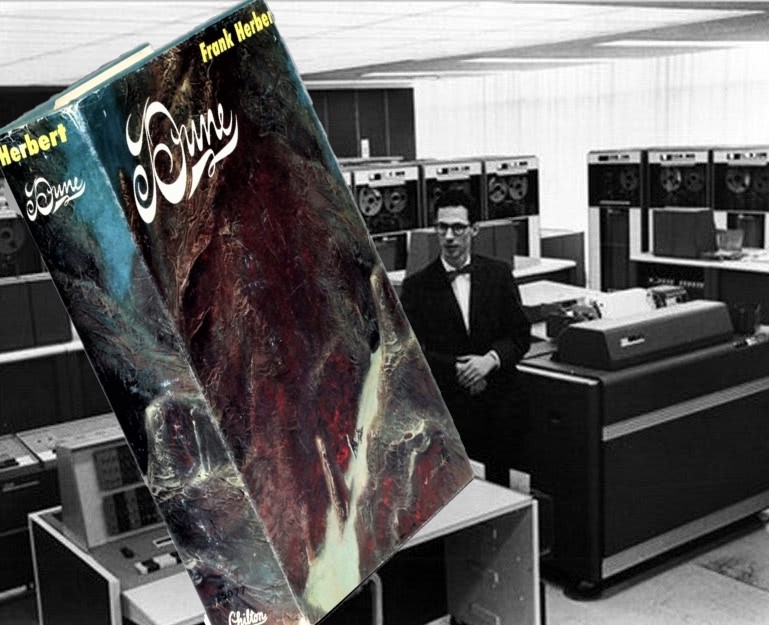
Paul Atreides’ prescience, the ability to see future events, in Frank Herbert’s ‘Dune’ is both a literary device and commentary on science throughout his novel. As a literary device, Herbert uses Paul’s ability to see the future as a way of foreshadowing events in the book. In Paul’s visions, the reader sees the destruction of the House Atreides, Paul meeting Chani and the Fremen, and his rise as a messianic figure. The author also shows how Paul may be the long-anticipated hero of this messianic story, the Kwisatz Haderach, as hinted in the scene with the Reverend Mother Gaius Helen Mohiam and the Gom Jabbar test. But Herbert also tells the reader another story, one about the danger of living in a deterministic society where freedom gives way to absolute predictability and control. The trap of the prescient as he calls it.
To understand Frank Herbert’s fear of a world where everything is determined and predictable you have to understand the times in which he lived. From the 1940s through the 1960s science was both the boon and a bane of human society. Through science, human beings could increase lifespan, end hunger and disease, and promote peace. Science could also make more devastating weapons and introduce the threat of a technocratic despotic state. Computers, or thinking machines, could orchestrate all aspects of human life and, with their ability to predict future events, create a static society where everything is determined and controlled. Herbert hated this idea, of the loss of free will, so much that in his book he had the “thinking machines” destroyed in a Great Jihad. He also postulated that this folly by the people who wanted to predict the future, to control the fate of others, would not end with that. So in ‘Dune’, Herbert introduces the reader to prescience, and Bene Gesserit’s eugenics program to achieve this goal, and how this could lead to the extinction of humankind.
The creation of the Kwisatz Haderach by the “witches” in the narrative gives the story both the reason for the central character, Paul Atreides, to be the messianic figure in this story and the theme which is the folly of predictability. Paul’s abilities set him apart from those around him through his visions of the future and foreknowledge of things he shouldn’t know. For example, when he knew how to wear his stillsuit for the first time or of his mother’s pregnancy with his sister. His visions of the future weren’t perfect, though. They were not always accurate and could even be open to interpretation as to when he failed to predict Gurney Halleck’s attack on his mother and the death of his first son, Leto. Paul himself described his prescience ability as a man traveling through the desert. When the traveler reaches the crest of a dune he can see for miles in the direction of his destination. It is only when he begins his journey, and climbs down to the lowest part of the dune, that his vision and sense of direction become obscured. Paul could see the future but once he attempts to move in that direction “his vision becomes obscured.” This is an analogy of computer efficiency in Herbert’s day. Computing technology was good at making short-term trend predictions but for predicting anything long-term with any accuracy it was virtually impossible. Like the traveler, the scientists could see their answers on the horizon but couldn’t see how to get there. In the novel, Paul saw an infinite number of scenarios, all equally valid, with the only difference being choosing the one least unfavorable. Instead of leading a conquering army on a bloody crusade under the Atreides banner, he chose the part of the messiah for the Fremen Jihad and Emperor of the Known Universe. Statistical analysts had the same problem, but not so dramatic. They also could see an infinite number of scenarios through the data they accumulated and from those chose the most plausible. If, they thought, you could build a better, faster thinking machine, a computer able to handle more data, then you could eliminate the uncertainty and make a better forecast of future events. Paul in his frustration in not being able to “see” Gurney Halleck’s attack on his mother echoes the same indignation futurists had with computing systems. They, like Paul, wanted a better way to improve their vision of the future, to make trends more predictable, and that is what Frank Herbert saw as dangerous.
Herbert wasn’t the only science fiction author writing stories about “science going amok”. If scientists were to create machines that controlled human society it would mean the extinction of humankind. It is an old trope with countless examples (it is still in use today with the fear of AI and life under the control of the machines!). In ‘Dune’, the electronic machines were replaced by “human computers”, the mentats. Mentats were human number crunchers which is what computing systems were at the time Herbert authored his novel. They perform copious amounts of numerical computations quickly so that the data can then be analyzed and propose workable solutions to problems. It was making short-term predictions by following the trends in the data. The more data that could be accumulated the more accurate the predictable outcomes. A mentat is only as good as the information it was given. It is no surprise that mentat training was part of Paul’s education through Thufir Hawat. Making reliable predictions, to see into the future, was the goal for developing supercomputers. Once you had such a system you can control multiple aspects of functionality, control the fates of others, and eliminate randomness. Control, and the end of free will, is what scared writers, like Frank Herbert, in this genre. But there were limitations in building such a system. There was a need for new programming algorithms and the miniaturization of transistor electronics. An intuitive leap in technology was necessary to create the kind of control in trends for long-term predictions. There was a need to shorten the way.
In the novel, Paul takes the “Water of Life” and makes his ascension to the level of the perfect seer. Computing technicians were doing the same in a way, through innovations in microchip technology and software, by building bigger and faster computing systems. To Frank Herbert this acquisition of technology was equivalent to Odin drinking from the Fountain of Wisdom and, as with Odin, it would come with a price. Paul drinks, pick the path of lesser evils (according to trend analysis seen as the possible scenarios in his visions), vanquishes his enemies, marries the princess, and becomes the new emperor. But what then, Herbert leaves us to ask? How will history judge us for following the words of the seer and ignoring the warnings of common wisdom (for Chani was wise!). Is the future a paradise of peace and plenty under the rule of the Perfect Prophet? Can a pre-deterministic controlled society, with no free will, end humankind’s problems? Frank Herbert continues his treatise on the scientific folly of predictability in his next three next books culminating with ‘God Emperor of Dune’. (To continue in Part Two)
“Trump will attempt to start or buy a media company that can compete with Fox News and do battle with everyone else.” This is what Timothy L. O’Brien wrote in a Bloomberg Opinion article on June 7th, 2020 (https://www.bloomberg.com/opinion/articles/2020-06-07/trump-s-ugly-week-reveals-how-he-wants-to-be-remembered). I see this as a strong likelihood because if there has been one constant in the Trump administration it’s that everything centers around him. If you have any doubt of this just remember this, he has publicly referred to himself as “the Chosen One”. His arrogance, his megalomaniacal view of self-worth, lacks any justification. Donald J. Trump is a farce of a man with no substance.
This administration has given us no peace treaty with North Korea or Afghanistan. We have no trade agreements with China, Japan, the European Union (though NAFTA has been tweaked it still cannot be called “NAFTA 2”), or OPEC. “Law and Order” President? No reforms in gun control regulation at any time in the foreseeable future despite the school and public mass shootings. On the global scene, North Korea is still a “rogue” nation, the Taliban is leaving peace talks, and we have no SALT Treaty with Russia. Healthcare? Despite the over 50 attempts to repeal the Affordable Healthcare Act by the GOP, Trump has not come up with a replacement (he does want to make changes to Medicare and Medicaid by allowing coverage through private insurers and cutting government spending). Immigration reform: increase in arrests and still pushing for a costly and mostly inefficient wall (there are alternatives in technology like the use of drones that would be more efficient and less costly).
Then there is what he has done. He has rolled back EPA standards and regulations almost to pre-Obama (even pre-Bush) times benefitting pollution producing industries like coal and petroleum. His Farm Relieve directives he signed to help farmers in the trade tariff war he created with China benefitted mostly the Big Agribusinesses and suppliers than small farms. He has increased funding to the Defense Department which mostly benefitted military manufacturers. Trump has stepped on state’s rights by rolling back interstate commercial transportation taxes. Talking about taxes, he has given tax credits to the wealthy and corporations with the idea that it will get to the regular worker (“trickle-down” has never worked before it will not work now). Oh, and he has bullied, insulted, and threatened everyone who has seen through incredulous scams. I can continue with the other debacles, “Russiagate”, Covid-19, George Floyd Protest, but why? We all saw it. His lack of leadership in any situation is very self-evident.
When November 3rd comes around I want you to remember the last 4 years and ask yourself this, must we allow this petty, shallow, self-gratifying man-child to serve another four more years? I hope your answer is no and that you vote for Joe Biden.
Donald Trump’s June 1st strolled from the White House to the steps of St. John’s Church for a staged photo-op. Moments before Washington D.C. police tear gassed peaceful George Floyd protesters to make way for the president’s entourage of White House administrators, secret service personnel, and chosen media.
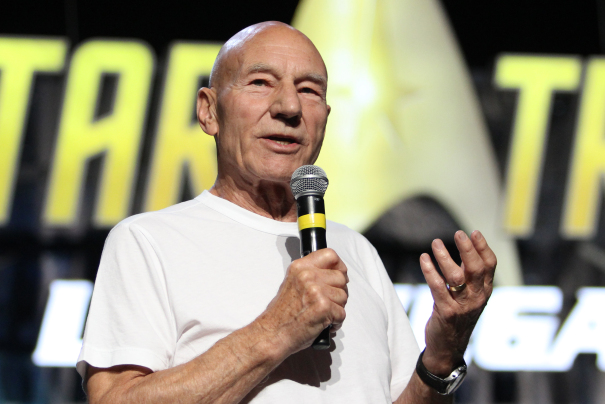
Exciting news! Star Trek: The Next Generation (TNG) is coming back and so is Sir Patrick Stewart. It was announced by Alex Kurtzman, Executive Producer of Star Trek: Discovery, and Stewart at Star Trek Las Vegas (Capt. Picard in New ‘Star Trek’ Series for CBS All Access). In an article earlier this year, also from Variety, I think, Kurtzman had suggested that an animated Star Trek series was in the works and that it would be a continuation, or reboot involving an alternate timeline TNG. I doubt it will be a live action because either all of the actors have aged too much for the roles (Brent Spiner, for example, can not be the age-less Data) or are involved in other projects (although, with Jonathan Frakes directing on DISCO, he could be available for voice roles). One more thing, animated series have worked really well for the Star War franchise so it’s only logical that Star Trek should do the same.
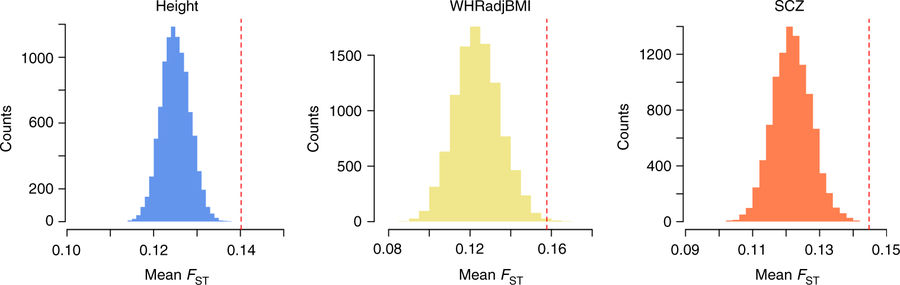
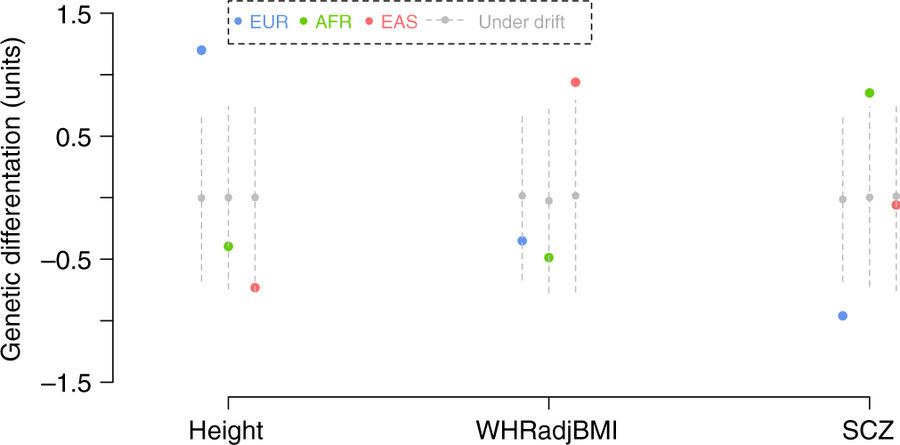
Research published from The University of Queensland indicates that natural selection plays a greater role than genetic drift in SNPs dealing with height, waist-to-hip ratio, BMI, and schizophrenia among European, African, and Asian populations (Does evolution make us or are we just drifting that way?). Led by Professor Jian Yang from UQ’s Institute for Molecular Bioscience and Queensland Brain Institute, the team used more than 400,000 genetic samples from African, East Asian and European populations to determine if the SNPs (pronounced as “snips”) showed a tendency towards randomness, implying genetic drift, or not, and thus natural selection.
The results showed that for SNPs such as height, waist-to-hip, BMI, and schizophrenia, there was a greater frequency for height among Europeans; a greater BMI number for Africans with Europeans having greater than Asians; both Europeans and Africans falling out of the mean for schizophrenia. None of these traits showed the tendency towards a random distribution which indicates that for these SNPs natural selection plays a greater role than genetic drift. In other words, what this study says that rather than in the colloquial debate of Nature versus Nurture it’s more like Selection over Nature and Nurture not having a factor at all. This is important in that it gives hope for the potential to treat certain ailments, such as schizophrenia through treatments such as CRISPR.
It has left me to wonder how much of natural selection over genetic drift influenced hominin traits? Eyebrows/brow ridges, robust/gracile, even “having a chin” how were these more a product of selectivity among groups than randomness among Neandertals, Denisovans, and modern humans? More intriguing, could this be applied to culture as well?
This morning I got a Twitter notification from All Revolutions (@RevolutionsCen) about an article from The Atlantic byEd Young (@edyong209 ) where, as he tells it in I Spent Two Years Trying to Fix the Gender Imbalance in My Stories , “I knew that I care about equality, so I deluded myself into thinking that I wasn’t part of the problem”. He had seen how a lot of his articles reflected a gender bias he never intended to portray. Reading this opened my eyes to the fact that even though I claim to be “gender-blind” I wasn’t doing any better. Here I’m thinking I’m a progressive thinking person now to find out I’m as dirty as our misogynist President (I wasn’t aware of Emmanuelle Charpentier, Jennifer Doudna, and CRISPR). I was fooling myself completely. Now I begin to wonder where else has my supposed “blindness” toward gender, race, or ethnicity has misled me to promote instead the same prejudices I have always felt unjust? The article is very enlightening. Also, it has good resource information at the end of it.
I thought about it as well, weighing the security breaches against staying in touch with people, and concluded that whatever I am worried that someone would get has already happened. Therefore, I’ve taken some steps to prevent any further excursions by outfits like Cambridge Analytica into mine and my friend’s lives. I’ve cut down my number of contacts down to a small, manageable number and of people I can control. Removed any pictures of my children and be careful of what I post in the future. I’ve also made access to certain information more restrictive. I won’t participate in surveys, test, and any of the other distractions FB had provided in the past. Note: I never understood why some of these would ask for a login to post on your profile if you were already logged in. Always seemed like a security violation.
Anyway, to keep in touch with family, former classmates, co-workers -friends, I will remain on FB. I will also remain to do so more carefully.










 Life On a Small Blue World©